

Overview
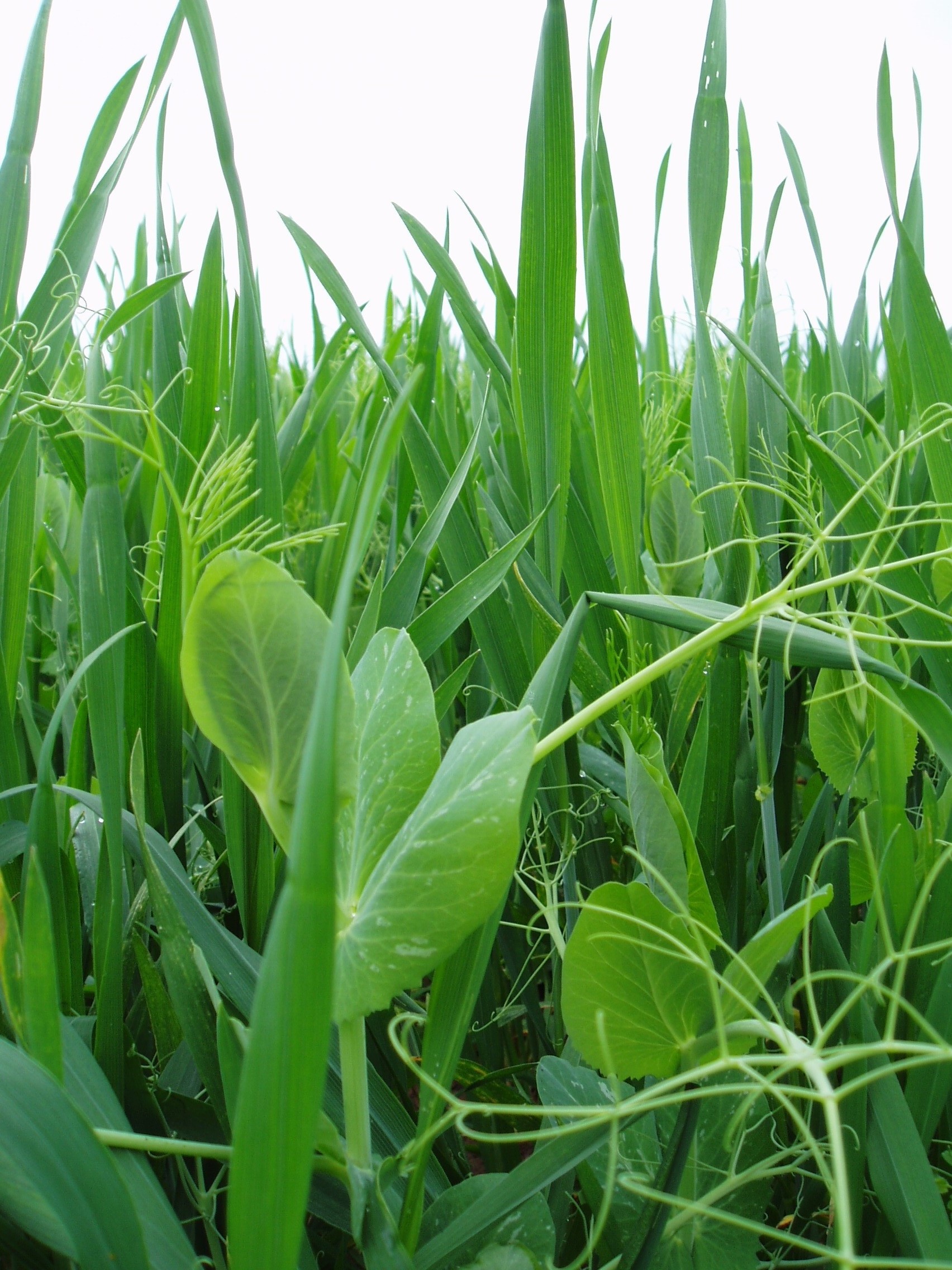
LEVA’s scientists have expertise in agronomy, crop ecophysiology, soil biology and statistics. Their research aims to mobilise biotic interactions for the design and management of intercrops including one or several legume species, in order to conceive low input cropping systems better adapted to global changes.
Mission and objectives
In the context of the agro-ecological transition and climate change, LEVA aims to contribute to the production, communication and dissemination of scientific knowledge, and to support advisors and farmers.
LEVA’s research focuses on annual crops, and takes place at different levels:
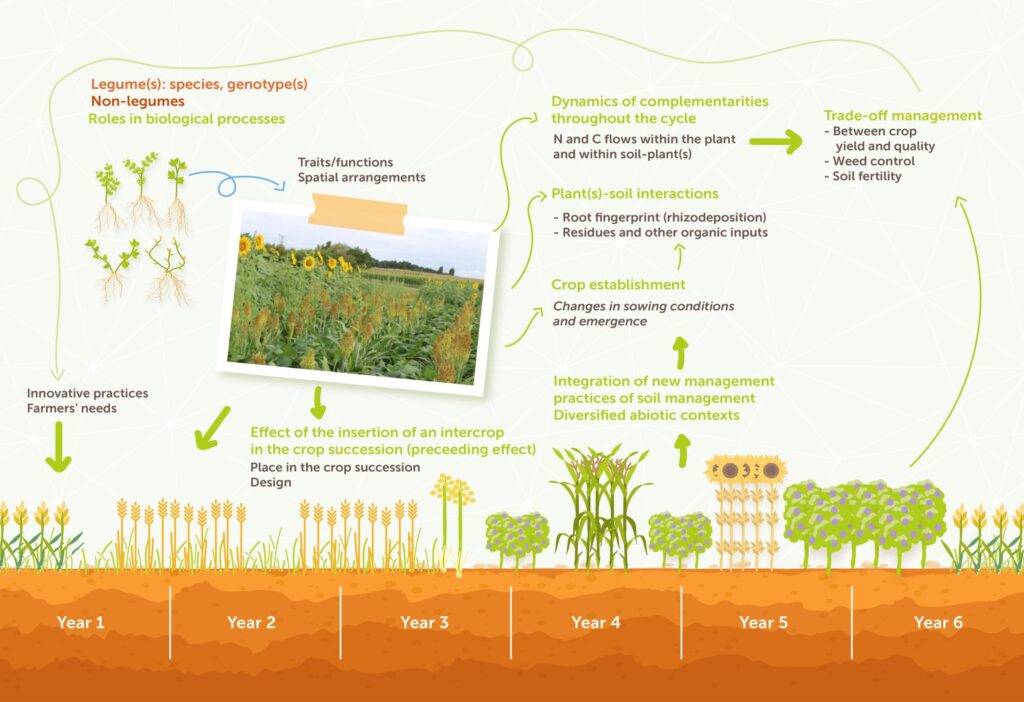
- Interactions between intercropped plant species within the plant(s)-soil system, related to the management of nitrogen and light resources
- Managing intercrops designed to enhance the ecological functions of legumes for providing ecosystem services, in line with farmers’ objectives (yield, crop quality, nitrogen management and soil fertility, weed control, etc.).
- Designing innovative spatio-temporal arrangements for building up diversified legume-rich and low-input cropping systems.
Research
LEVA’s research takes place within the framework of the agro-ecological transition, climate change, and the increasing need for protein-rich crops. It mainly focuses on intercropping legumes with another crop for improving the sustainability and nitrogen efficiency of innovative cropping systems. The LEVA team investigates how intercropping with legumes can help manage the trade-offs between services through the choice of species and genotypes, and also by combining these factors with spatial arrangements and practices in contrasting abiotic contexts. Based on a functional approach, LEVA’s research takes into account the challenge of achieving the ecosystem services linked to symbiotic fixation in the context of reduction of herbicides, as legumes are sensitive to weeds.
This work aims to guide the design of intercrops including legumes according to local contexts, and meeting farmers’ goals.
Our multidisciplinary team has expertise in:
- Field and cropping system agronomy, agro-ecology, functional ecology (soil fauna, plant ecology), plant physiology, statistics;
- Ecophysiology of legumes, measurement of nitrogen fluxes in the atmosphere-plant-soil continuum (atmospheric nitrogen fixation and rhizodeposition), isotopic methods, root growth monitoring, etc.
- Design and management of intercrops including legumes, in relation to different production objectives (yield, crop quality, weed control, soil fertility, etc.), in contrasting abiotic environments.
- Innovative cropping systems for protein production, less nitrogen fertilizers, herbicides and greenhouse gas emissions, more resilient to drought, and adapted to future challenges.
LEVA carries out experiments in climatic chambers, greenhouses and in the field, and adapts models to intercrops functionning. The team also participates with other labs in the development of methods and tools for evaluating innovative cropping systems (multicriteria analyses, life cycle analyses and indicators of soil biological activity).
The LEVA research unit has, among other things
- a greenhouse and a climate chamber
- a van fitted out as a laboratory with equipment for in situ measurements and sampling in fields with contrasting agronomic conditions, at technical partners’ and farmers’ sites
- equipment for collecting soil samples
- a near-infrared Fourier transform spectrometer
- an oximeter
- a nitrogen residue analysis system (continuous flow)
- a fibre analyser
- mills
- incubators
- a threshing machine
The LEVA works in partnership with PLATIN’ isotope analysis (Caen) and facilities of the SFR QUASAV. For field trials, LEVA has built a partnership with the Thorigné d’Anjou experimental farm and the FNAMS.
LEVA is located on two sites: at ESA (55 rue Rabelais, Angers) and on the Campus du Végétal (42 rue Georges Morel, Beaucouzé).
- All types of agriculture
- Nitrogen rhizodeposition
- Intercropping with legumes
- Biological nitrogen fixation
- Sustainability of cropping systems
- Above and belowground interactions
- Adaptation to abiotic constrained environments
- Crop diversification
Team of research unit

FUSTEC Joëlle
Enseignante-chercheuse en Agro-écologie|Habilité(e) à Diriger des Recherches (HDR)|Responsable de l’Unité de Recherche LEVA

BEROUEG Amira
Enseignante-chercheuse en agronomie
BOUSSELIN Xavier
Enseignant – Chercheur en Agronomie

CANNAVACCIUOLO Mario
Enseignant-chercheur en statistiques et biologie des sols

CASSAGNE Nathalie
Enseignante-Chercheuse en Ecologie et Agroécologie
LORIN Mathieu
Enseignant-Chercheur en Agronomie
NAUDIN Christophe
Directeur du Programme Ingénieur|Enseignant-Chercheur en Agronomie|Habilité(e) à Diriger des Recherches (HDR)
PIVA Guillaume
Enseignant-Chercheur en Agronomie
Projects research
Consultancy Services
LEVA’s scientific and technical expertise lies in agro-ecological innovation in the field of cropping systems within the framework of diversified cropping systems combining productivity and high environmental value:
LEVA is developing an indicator of soil biological activity, the LEVAbagTM (www.levabag.com), which is a means of assessing of the quality of organic matter in agricultural soils.
Contact: LEVAbag@groupe-esa.com
Our scientists provide training on the following topics:
- Functioning and management of intercrops including legumes
- Assessment of biological fixation and nitrogen rhizodeposition by crops
- Characterisation of soil biological activity
Study programmes
Teaching
LEVA’s researchers are involved in teaching and supervising trainees at Master’s level, especially ESA engineers (Plant Production and Agroecology specialisation), as well as Ph.D students. They are also involved in other Master’s courses (Plant Biology in Angers).
Internships
The Unit can accommodate interns at the end of engineering studies or Master 2.
Partners
Professional partners
- Terrena, Bejo Production
- Terres Inovia, Chambres d’Agricultures, Experimental farm of Thorigné d’Anjou, FNAMS, GEVES, RMT Champs et Territoires, LEGGO network, (Légumineuses à graines Grand Ouest), BASE network, REVA network , AVSF (Agronomes et Vétérinaires Sans Frontières)
Pôle de compétitivité Végépolys Valley, SATT Ouest Valorisation
Publications
2024
Bousselin X., Baux A., Lorin M., Fustec J., Cassagne N., Valantin-Morison M. 2024. Effect of different service plants grown in mixture on winter oilseed rape. European Journal of Agronomy 154, 127097. https://doi.org/10.1016/j.eja.2024.127097.
Bousselin X., Lorin M., Valantin-Morison M., Fustec J., Cassagne N., Baux A. 2024. Determinants of oilseed rape-service plant intercropping performance variability across a farmers’ fields network in Western Switzerland. Agronomy for Sustainable Development 44, 40. https://doi.org/10.1007/s13593-024-00972-6.
F. Vautrin, P. Piveteau, M. Cannavacciuolo, P. Barré, C. Chauvin, C. Villenave, D. Cluzeau, K. Hoeffner, P. Mulliez, V. Jean-Baptiste, G. Vrignaud, J. Tripied, S. Dequiedt, P.A. Maron, L. Ranjard, S. Sadet-Bourgeteau, 2024. The short-term response of soil microbial communities to digestate application depends on the characteristics of the digestate and soil type, Applied Soil Ecology 193, 105105. https://doi.org/10.1016/j.apsoil.2023.105105.
I. Maitre, L. Akissoe, B. Guerin, G. Piva, R. Symoneaux, M. Dufrechou and C. Brasse. 2024. Simplifying a multi-sensory gastronomic experience to identify the culinary potential of legumes: A proof of concept. Science Talks. https://doi.org/10.1016/j.sctalk.2024.100352
2023
Cheriere T., Lorin M., Corre-Hellou G. 2023. Choosing the right associated crop species in soybean-based intercropping systems: Using a functional approach to understand crop growth dynamics. Field Crops Research 298, 108964. https://doi.org/10.1016/j.fcr.2023.108964
Drut B., Fustec J., Oddos L., Cannavacciuolo M., Brauman A., Cassagne N. 2023. The combined effects of faba bean and endogeic earthworms on soil microbial activity in intercrops. European Journal of Soil Biology 117, 103510. https://doi.org/10.1016/j.ejsobi.2023.103510.
Vautrin F., Piveteau P., Cannavacciuolo M., Barré P., Chauvin C., Villenave C., Cluzeau D., Hoeffner K., Mulliez P., Jean-Baptiste V., Vrignaud G., Tripied J., Dequiedt S., Maron P.A., Ranjard L., Sadet-Bourgeteau S. The short-term response of soil microbial communities to digestate application depends on the characteristics of the digestate and soil type. Applied Soil Ecology. https://doi.org/10.1016/j.apsoil.2023.105105.
2022
Gardarin A., Celette F., Naudin C., Piva G., Valantin-Morison M., Vrignon-Brenas S., Verret V., Médiène S. 2022. Intercropping with service crops provides multiple services in temperate arable systems: a review. Agronomy for Sustainaible Development 42, 39. https://doi.org/10.1007/s13593-022-00771-x.
Boeglin L., Morère Le-Paven M.-C., Clochard T., Fustec J., Limami A.M. 2022. Pisum sativum Response to Nitrate as Affected by Rhizobium leguminosarum-Derived Signals. Plants 11, 1966. https://doi.org/10.3390/plants11151966.
Karimi B., Sadet-Bourgeteau S., Cannavacciuolo M., Chauvin C., Flamin C., Haumont A., Jean-Baptiste V., Reibel A., Vrignaud G., Ranjard L. 2022. Impact of biogas digestates on soil microbiota in agriculture: a review. Environmental Chemistry Letters. https://doi.org/10.1007/s10311-022-01451-8.
Dayoub E., Piva G., Shirtliffe S.J., Fustec J., Corre-Hellou G., Naudin C. 2022. Species choice influences weed suppression, N sharing and crop productivity in oilseed rape-legume intercrops. Agronomy 12(9), 2187. https://doi.org/10.3390/agronomy12092187.
Revoyron E., Le Bail M., Meynard J.-M., Gunnarsson A., Seghetti M., Colombo L. 2022. Diversity and drivers of crop diversification pathways of European farms. Agricultural Systems 201. https://doi.org/10.1016/j.agsy.2022.103439.
2021
Lefort C., Raveneau MP., Cannavacciuolo M., Guerry B., Fustec J. 2021. Predictors for assessing the flowering duration and dynamics of the complex umbellate of fennel in seed production. Annals of Applied Biology, doi: 10.1111/aab.12685.
Viguier L., Bockstaller C., Cavan N., Dubois S., Keichinger O., Toqué C., Toupet de Cordoue A.L., Corre-Hellou G., Angevin F. 2021. Combining diversification practices to enhance the sustainability of conventional cropping systems. European Journal of Agronomy, DOI: 10.1016/j.eja.2021.126279.
Gaudio N., Violle C., Gendre X., Fort F., Mahmoud R., Pelzer E., Médiène S., Hauggaard-Nielsen H., Bedoussac L., Bonnet C., Corre-Hellou G., Couëdel A., Hinsinger P., Jensen E.S., Journet E.P., Justes E., Kammoun B, Litrico I., Moutier N., Naudin C., Casadebaig P. 2021. Interspecific interactions regulate plant reproductive allometry in cereal-legume intercropping systems. Journal of Applied Ecology. doi/abs/10.1111/1365-2664.13979.
Bousselin X., Cassagne N., Baux A., Valantin-Morison M., Herrera J.-M., Lorin M., Hédan M., Fustec J. 2021. Interactions between plants and plant-soil in functionally complex mixtures including grass pea, faba bean and niger, intercropped with oilseed rape. Agronomy. 11(8), 1493. doi.org/10.3390/agronomy11081493.
Jouan J., Carof M., Baccar R., Bareille N., Bastian S., Brogna D., Burgio G., Couvreur S., Cupial M., Dufrêne M., Dumont B., Gontier P., Jacquot A.-L., Kanski J., Magagnol S., Makulska J., Peres G., Ridier A., Salou T., Sgolastra F., Szelag-Sikora A., Tabor S., Tombarkiewicz B., Weglarz A., Godinot O. 2021. SEGAE: An online serious game to learn agroecology. Agricultural Systems. doi.org/10.1016/j.agsy.2021.103145.
2020
Malagoli P., Naudin C., Vrignon-Brenas S., Sester M., Jeuffroy M.-H., Corre-Hellou G. 2020. Modelling nitrogen and light sharing in pea-wheat intercrops to design decision rules for N fertilisation according to farmers’ expectations. Field Crops Research, 255, 107865. doi.org/10.1016/j.fcr.2020.107865.
Cheriere T., Lorin M., Corre-Hellou G. 2020. Species choice and spatial arrangement in soybean-based intercropping: Levers that drive yield and weed control. Field Crops Research, 256, 107923. doi.org/10.1016/j.fcr.2020.107923.
Carton N., Naudin C., Piva G., Corre-Hellou G. 2020. Intercropping Winter Lupin and Triticale Increases Weed Suppression and Total Yield. Agriculture, doi.org/10.3390/agriculture10080316.
Jouan J., De Graeuwe M., Carof M., Baccar R., Bareille N., Bastian S., Brogna D., Burgio G., Couvreur S., Cupiał M., Dumont B., Jacquot A.-L., Magagnoli S., Makulska J., Maréchal K., Pérès G., Ridier A.,Thibault Salou T., Tombarkiewicz B., Sgolastra F., Godinot O. 2020. Learning Interdisciplinarity and Systems Approaches in Agroecology: Experience with the Serious Game SEGAE. Sustainability, 12, 4351. https://doi.org/10.3390/su12114351
2019
Bobille B., Fustec J., Robins J. R., Cukier C., Limami A. M. 2019. Effect of water deficit on root exudation of amino acids by Pisum sativum. Phytochemistry 161, 75–85. https://doi.org/10.1016/j.phytochem.2019.01.015.
Mawois M., Revoyron E., Vidal A., Casagrande M., Jeuffroy MH., Le Bail M. 2019. Transition to legume-based farming systems requires stable outlets, learning and peer-networking. Agronomy for Sustainable Development 39, 1-14.doi:10.1007/s13593-019-0559-1.
2018
Drut B., Cassagne N., Cannavacciuolo M., Le Floch G., Cobo-Diaz J. F., Fustec J. 2017. Synergistic effects between wheat-clover intercrops and earthworms improve wheat performance. Journal of Agricultural Science 10 (12):1-14. doi:10.5539/jas.v10n12p1.
Vrignon-Brenas S., Célette F., Piquet-Pissaloux A., Corre-Hellou G., David C. 2018. Intercropping strategies of white clover with organic wheat to improve the trade-off between wheat yield, protein content and the provision of ecological services by white clover. Field Crops Research 224, 160-169. doi: org/10.1016/j.fcr.2018.05.009.
Carton N., Naudin C., Piva G., Corre-Hellou G. 2018. Variability of traits associated with early N acquisition in lupin and early complementarity in lupin-triticale mixed stands. AoB Plants doi: 10.1093/aobpla/ply001.
Karimi B., Sadet-Bourgeteau S., Cannavacciuolo M., Chauvin C., Flamin C., Haumont A., Jean-Baptiste V., Reibel A., Vrignaud G. et Ranjard L., 2023 – Impact des digestats de méthanisation sur la qualité microbiologique des sols agricoles : état des connaissances, Étude et Gestion des Sols, 30, 169-194
Bousselin X., Cassagne N., Baux A., Valantin-Morison M., Lorin M., Hédan M., Fustec J. 2021. Plant-soil and plant-plant interactions in winter oilseed rape intercropped with service plants: Are there functional differences between species?. Intercropping for sustainability: Research developments and their application, Aspects of Applied Biology, 146, 4 pages.
Bousselin X., Baux A., Fustec J., Lorin M., Cassagne N., Valantin-Morison M. 2021. Complex intercropping of winter oilseed rape with frost sensitive service plants: How to explain ecosystem services variability?, Intercropping for sustainability: Research developments and their application, Aspects of Applied Biology, 146, 6 pages.
Boeglin L., Limami A.M., Fustec J. 2021. Rhizobium effect on lateral root development of pea under various nitrate concentrations in the early growth: a phenotype study. Intercropping for sustainability: Research developments and their applications, Aspects of Applied Biology, 146, 6 pages.
Enjalbert J., Litrico I., Fournier E., Médiène S., Gauffreteau A., Borg J., Corre-Hellou G., Goldringer I., Hanachi M., Journet E.-P., Justes E., Morel J.-B., Naudin C., Sanguin H., Valentin-Morison M., Verret V., Bedoussac L.. 2019. Mélanges variétaux et mélanges plurispécifiques – atouts et contraintes. Innovations Agronomiques, 75: 49-71.https://www6.inra.fr/ciag/Revue/Volumes-publies-en-2019/Volume-75-Mai-2019
Valantin-Morison M., Verret V., Médiène S., Lorin M., Pelzer E., Celette F., Naudin C. 2019. ALLIANCE : Amélioration des performances écologiques et économiques par association de plantes de services Légumineuses dans des systèmes de grandes cultures. Innovations Agronomiques 55, 349-365.
Fontaine L., Celette F., Cordeau S., Métais P., Vacher C., Cohan J.-P., Fourrié L., Jouany C.,Leclerc B., Véricel G., Vian J.-F., Aveline A., de Cordoue A.-L., Boissinot F., Burel E., Castel L.,Champion J., Desclaux D., Dupont A., Le Bras M., Prieur L., Quirin T.,Thévenon P., Casagrande M. 2019. InnovAB – Améliorer les systèmes de grande culture en agriculture biologique : enseignements d’un réseau d’expérimentations de longue durée. Innovations Agronomiques 71, 295-309.
Drut B., Cassagne N., Cannavacciuolo M., Brauman A., Le Floch G., Cobo-Diaz J.F., Fustec J. 2018. Mobilization of interactions between functional diversity of plant and soil organisms on nitrogen availability and use. Aspects of Applied Biology 138, 31-42.
Baccar R., Hellou G., Fustec J. 2018. Dynamic of lupin-cereal intercrop and interaction with soil nitrogen during early stages of development. Aspects of Applied Biology 138, 69-79.
Bobille H., Fustec J., Robins J. R., Cukier C., Limami A.M. 2018. Amino acid fingerprint in the rhizosphere of Pisum sativum in response to water stress. Aspects of Applied Biology 138, 81-84.
Revoyron E., Vidal A., Cassagrande M., Jeuffroy M.-H., Lebail M., Mawois M. 2018. Trajectories of Legumes insertion in farms: methodological framework for the analysis of long-term. Aspects of Applied Biology 138, 99-107.
Corre-Hellou G. 2021. Les légumineuses dans des systèmes de culture sans pesticides ? Rencontres Francophones Légumineuses – RFL3. ESA Angers (France), 24-25 February 2021 – https://www.rfl-legumineuses.com/.
Corre-Hellou G. 2021. Légumineuses comme plantes de service dans les systèmes de cultures intérêts, retours d’expériences et points de vigilance. RFL3. ESA Angers (France), 24-25 February 2021 -https://www.rfl-legumineuses.com/.
Lefort C., Raveneau M.-P., Fustec J. 2021. Effect of climatic factors on flowering durations and dynamics in fennel seed production. Plantum Seed Technology webinar. 12 May 2021.
Guy M., Lorin M., Bousselin X., Corre-Hellou G. 2024. Intercropping chickpea with a mechanically controlled service plant: a promising way to manage weeds while mitigating interspecific competition. 18th Congress of the European Society for Agronomy, 26-30 August 2024, Rennes, France (communication orale)
Baux A., Bousselin X., Magnin L., Laurent E.A., NussbaumV., Breitenmoser S., HiltpoldIs I. 2024. Rapeseed – service plants intercropping a solution to mitigate biotic stresses? 18th Congress of the European Society for Agronomy, 26-30 August 2024, Rennes, France (communication orale)
Corre-Hellou G., Vandewalle A., Angevin F., Bockstaller C., Stilmant D., Messean A. 2024. Synergies between short and long-term actions to promote crop diversification. 18th Congress of the European Society for Agronomy, 26-30 August 2024, Rennes, France (Communication orale)
Fustec J., Pidon H., Benslimane A., Bodinier M., Gagnaire V., Harzic N., Naudin C., Symoneaux R., Tayeh N. Tcherkez G., 2024. PULSAR: a France 2030 project for unlocking white lupin from field to fork. 18th Congress of the European Society for Agronomy, 26-30 August 2024, Rennes, France. (Poster)
Sadet-Bourgeteau S., Vautrin F., Piveteau P., Cannavacciuolo M., Barré P., Chauvin C., Villenave C., Cluzeau D., Hoeffner K., Mulliez P., Jean-Baptiste V., Vrignaud G., Cottin A., Tripied J., Dequiedt S., Maron P.A., Ranjard L. 2023. Microbial communities from different soil types respond differently to different digestate fractions input. GSB, Mars 2023, Dublin, Irlande (Poster).
Vautrin F., Piveteau P., Cannavacciuolo M., Barré P., Chauvin C., Cluzeau D., Hoeffner K., Mulliez P., Jean-Baptiste V., Tripied J., Dequiedt S., Maron P.A., Vrignaud G., Ranjard L., Sadet-Bourgeteau S. 2022. Microbial communities from different soil types respond differently to digestates inputs. ISME, August 2022, Lausanne, Suisse (Poster).
Sadet-Bourgeteau S., Vautrin F., Piveteau P., Cannavacciuolo M., Barré P., et al.. 2022. Short-term impact of biogas digestates on soils microbial communities. Revista de Investigaciones de Ciensias Agronomicas de la Facultad de Ciencias Agrarias de la Universidad Nacional de Rosario, 2022, 40, pp.102 (Poster)
Diallo I., Hoeffner K., Fiala D., Lévêque N., Morand L., Barré P., Cannavacciuolo M., Chauvin C., Dequiedt S., Johnson M., Maron P.A., Montenach D., Mora-Salguero D., Morvan T., Mulliez P., Piveteau P., Ranjard L., Sadet-Bourgeteau S., Stangret V., Vautrin F., Vrignaud G., Cluzeau D. 2022. Effect of anaerobic digestate application over annual crops on earthworm communities. ISSE, Juillet 2022, Rennes, France (Poster)
Bousselin X., Fustec J., Valantin-Morison M., Lorin M., Cassagne N., Hedan M., Laurent E.A., Fridén L., Baux A. 2021. Is diversity of service plant species a way to achieve higher biomass and N accumulation in rapeseed-service plant intercropping? Biofumigation 7 : International Symposium on Biocidal and Non-Biocidal Plants to improve Soil Health. 22-26 March 2021. Crans-Montana, Switzerland. On line event (communication orale).
Kerebel A., Cannavacciuolo M., Emiel R., Piva G., Fustec J. 2021. Réponse des traits racinaires du colza et de la féverole à la culture en association et à la fertilisation azoté et soufrée. Rencontres Francophones Légumineuses – RFL3. 24-25 February 2021, ESA Angers (France). On line event, https://www.rfl-legumineuses.com/ (communication orale)
Boeglin L., Limami A.M., Fustec J. 2021. Ramification du système racinaire du pois en réponse au nitrate et Rhizobium pour un meilleur contrôle des adventices dans les associations pois-colza. Rencontres Francophones Légumineuses – RFL3. 24-25 February 2021, ESA Angers (France). On line event, https://www.rfl-legumineuses.com/ (communication orale)
Cheriere T., Lorin M., Corre-Hellou G. 2021. Associations d’espèces : un levier pour favoriser l’insertion de légumineuse ; exemples d’associations innovantes à base de soja. RFL3. 24-25 February 2021, ESA Angers (France). On line event, https://www.rfl-legumineuses.com/ (communication orale)
Bousselin X., Baux , Valantin-Morison M., Lorin M., Cassagne N. , Hédan M. , Nussbaum V., Guillet R., Fridèn L., Izard M., Kneib C., Fustec J. 2021. Plantes de services : choix des espèces de légumineuses gélives au sein des mélanges d’espèces associés au colza d’hiver. RFL3. 24-25 February 2021, ESA Angers (France). On line event, https://www.rfl-legumineuses.com/ (communication orale)
Viguier L., Bockstaller C., Keichinger O., Angevin F, Corre-Hellou G. 2021. Les légumineuses dans des systèmes diversifiés : quels services et quels points de vigilance ? RFL3. 24-25 February 2021, ESA Angers (France). On line event, https://www.rfl-legumineuses.com/ (communication orale).
Boeglin L., Limami A.M., Fustec J. 2021. Rhizobium effect on lateral root development of pea under various nitrate concentrations in the early growth: a phenotype study. Intercropping for sustainability: Research developments and their application (poster et pitch).
Fustec J., Cannavacciuolo M., Ben El Ghali M., Corre-Hellou G. 2021. DiVicia, un projet PRIMA pour la restauration de l’agrodiversité de vesces dans les systèmes céréaliers méditerranéens. RFL3. 24-25 February 2021, ESA Angers (France). On line event, https://www.rfl-legumineuses.com/ (communication affichée + pitch))
Nathalie C., Baptiste D., Oddos L., Cannavacciuolo M., Fustec J. 2021. L’effet stimulant des vers de terre et des légumineuses dans l’environnement rhizosphérique du blé et du colza. RFL3. 24-25 February 2021, ESA Angers (France). On line event, https://www.rfl-legumineuses.com/ (communication affichée + pitch)
Cheriere T., Lorin M., Corre-Hellou G. 2020. Intercropping: a tool for cropping system diversification. XVI European Society for Agronomy Congress, 1-3 September 2020, Sevilla, Spain. On line event (communication orale).
Bousselin X., Cassagne N., Baux A., Valantin-Morison M., Hedan M., Cannavacciuolo M., Lorin M., Fustec J. 2020. Choosing service plant for intercropping with rapeseed based on plant-plant and plant-soil interactions. XVI European Society for Agronomy Congress, 1-3 September 2020, Sevilla, Spain. On line event (communication orale).
Boeglin L., Friant C., Peligry C., Limami A.M., Fustec J. 2019. Early nodule detection by staining with 2,3,5-triphenyltetrazolium chloride. Third International Legumes Society Conference, 21-24 May 2019, Poznan, Poland. (Poster).
Cherière T., Lorin M., Corre-Hellou G. 2019. Soybean based intercrops effects on soil mineral nitrogen pool for the following crop. Third International Legumes Society Conference, 21-24 May 2019, Poznan, Poland. (Poster).
Baccar R., Corre-Hellou G., Bousselin X., Cherière T., Mauline M., Lorin M. 2019. Nitrogen acquisition and allocation in lupin and its effects on the following cereal crop in agricultural conditions. Third International Legumes Society Conference, 21-24 May 2019, Poznan, Poland. (Poster).
Mahmoud R., Gaudio N., Casadebaig P., Gendre X., Bedoussac L., Corre-Hellou G., Fort F., Journet E-P., Litrico I., Naudin C., Violle C. 2018. A trait-based approach to understand and predict the performance of arable annual mixed crops. In proceedings of International Conference on Ecological Sciences (sfécologie2018), 22-25 October 2018, Rennes, France, pp15-16. (comm. orale)
Corre-Hellou G., Carton N., Dayoub E., Deneufbourg F., Bouet S., Janus F., Piva G., Naudin C. 2018. Spatial diversification to reduce the use of herbicides. XV European Society for Agronomy Congress, 27-31 August 2018, Geneva (CH).
Revoyron E., Vidal A., Cassagrande M., Jeuffroy M.-H., Lebail M., Mawois M. 2018. Trajectories of Legumes insertion in farms: methodological framework for the analysis of long-term changes Advances in Legume Science and Practice, Association of Applied Biologists Conference, 21 – 22 March 2018, Jury’s Inn, Glasgow (UK).
Drut B., Cassagne N., Cannavacciuolo M., Brauman A., Le Floch G., Cobo-Diaz J.F., Fustec J. 2018. Mobilization of interactions between functional diversity of plant and soil organisms on nitrogen availability and use. Advances in Legume Science and Practice, Association of Applied Biologists Conference, 21 – 22 March 2018, Jury’s Inn, Glasgow (UK).
Baccar R., Hellou G., Fustec J. 2018. Dynamic of lupin-cereal intercrop and interaction with soil nitrogen during early stages of development., Advances in Legume Science and Practice, Association of Applied Biologists Conference, 21 – 22 March 2018, Jury’s Inn, Glasgow (UK).
Bobille H., Fustec J., Robins J. R., Cukier C., Limami A.M. 2018. Amino acid fingerprint in the rhizosphere of Pisum sativum in response to water stress. Advances in Legume Science and Practice, Association of Applied Biologists Conference, 21 – 22 March 2018, Jury’s Inn, Glasgow (UK).
Mulliez P., Cannavacciuolo M. 2023. Metha-Biosol : impact des digestats de méthanisation sur la qualité biologique des sols agricoles. 16è Rencontres de la fertilisation raisonnée et de l’analyse Comifer-Gemas, 21-22 et 23 novembre 2023, Tours, France. (Communication orale).
Riou V., Hubert C., Piron D., Mulliez P., Cannavacciuolo M., Bailly A., Husson C., Bourgeteau-Sadet S., Hermant A., Scherer A., Moreira M., Reibel A., Levet A., Vrignaud G., Haumont A., Chauvin C., Barre P., Mora-Salguero D., Piveteau P., Cluzeau D., K. Hoeffner K. 2023. Impacts des pratiques agricoles sur la qualité biologique des sols sur un réseau de fermes utilisant des digestats. 16è Rencontres de la fertilisation raisonnée et de l’analyse Comifer-Gemas, 21-22 et 23 novembre 2023, Tours, France. (Poster).
Mora-Salguero D., Chauvin C., Bailly A., Gilles M., Montenach D., Johnson M., Morvan T., Piron D., Hoeffner K., Mulliez P., Cannavacciuolo M. 2023 Effet d’un apport répété de digestats sur la qualité biologique des sols agricoles. 16è Rencontres de la fertilisation raisonnée et de l’analyse Comifer-Gemas, 21-22 et 23 novembre 2023, Tours, France. (Poster).
Cannavacciuolo M. & Mulliez P. 2024. Metha-Biosol : Impact des digestats de méthanisation sur la qualité biologique des sols. Réseau Mixte Technologique BOUCLAGE, 15 Mai 2024, Angers, France
Maitre I., Akissoe L., Guérin B., Piva G., Symoneaux R., Dufrechou M., Brasse C. 2023. Simplifying a Multi-Sensory Gastronomic Experience to Identify the Culinary Potential of Legumes: A Proof of Concept. 15th Pangborn Sensory Science Symposium – Meeting New Challenges in a Changing World (PSSS 2023): O17, Available at SSRN: https://ssrn.com/abstract=4550185
Mawois M., Revoyron E., Vidal A., Casagrande M., Jeuffroy M.-H., Le Bail M. 2018. Freins et leviers au développement des légumineuses dans les exploitations agricoles : Etude des trajectoires de changement technique dans des exploitations agricoles de deux territoires (Bourgogne et Pays de la Loire). Colloque de restitution finale du projet ANR Legitimes, 10 juillet 2018, Paris, France.
Lefort C. 2018. Environment impact during seed development on fennel seed germination quality.2nd International Symposium “Carrot and other apiaceae”, 19-22 septembre 2018, Krakow, Pologne.
Corre-Hellou G., Pelzer E., Journet E.P. 2018. Quantifier pour optimiser les services rendus par les légumineuses en exploitations agricoles. Séminaire de restitution du projet ANR LEGITIMES, 10 juillet 2018, Paris, France.
Bouet S., Corre-Hellou G. 2018. Implantation sous couvert et cultures associées en production de semences : intérêt et perspectives pour la maîtrise des adventices. SIVAL,18 janvier 2018, Angers, France.
Fustec J. 2018. Les enjeux de l’augmentation de la diversité cultivée et les objectifs du projet SAFARI. Journée de restitution du projet PAO SAFARI, 9 avril 2018, ESA Angers, France.
Drut B. 2018. Interactions entre couvert végétal et organismes du sol pour une meilleure nutrition des plantes. Journée de restitution du projet PAO SAFARI, 9 avril 2018, ESA Angers, France.
Cassagne N. 2018. Effet de la diversité génétique des blés sur les nématodes et le fonctionnement biologique du sol. Journée de restitution du projet PAO SAFARI, 9 avril 2018, ESA Angers, France.
Lorin M. 2018. Utiliser les plantes de service pour gérer les adventices. Les entretiens de l’AEI, « Les couverts végétaux dans une perspective post-glyphosate ». 1ères Jounées Agrodiversité : « Comment augmenter l’Agrodiversité dans les systèmes agricoles ? », 21, 22, 23 février 2018, ESA Angers, France.
Fustec J. 2018. Interactions entre les racines du colza et des plantes compagnes dans une association, et impact sur la disponibilité soufrée. Etude des complémentarités racinaires (colza/féverole). Assemblée générale de l’Association BASE. 1ères Journées Agrodiversité : « Comment augmenter l’Agrodiversité dans les systèmes agricoles ? », 21, 22, 23 février 2018, ESA Angers, France.