Higher National Technical Diploma in Livestock Management
The Higher National Technical Diploma in …. enables you to become a livestock management specialist, providing advice to farm managers whilst working within cooperatives, businesses or chambers of agriculture. Do you want to become a livestock farmer? This course is also for you!

Code RNCP : 39685 | Code diplôme : 32321207
Content updated on 3 September 2026
-
Nature :
Qualification-leading course
-
Lenght of training:
2 years
-
Terms and conditions:
Work-study programme
-
Status:
Holder of a Level 4 qualification: A-levels (general, technological or vocational) or equivalent
Code RNCP : 39685 | Code diplôme : 32321207
Content updated on 3 September 2026
Overview
Objectives
In addition to setting up or managing production facilities, this HND leads to positions of responsibility. As a livestock management specialist, you will be able to advise farm managers whilst working within cooperatives, companies or chambers of agriculture.
The course enables you to:
- acquire a solid understanding of all animal production techniques
- learn all aspects of livestock management: feed quality, animal growth, reproduction, genetic improvement, handling and procedures involving animals, health monitoring, animal welfare, adaptation of buildings, etc.
- to be able to provide technical advice on the production, management and operation of a farming business
It covers all activities related to animal production. The comprehensive approach to the economic, scientific and technical concepts related to animals enables students to master the management of livestock and production systems within their respective sectors.
During the course, you will explore all the factors and constraints involved in animal management: zootechnics, livestock management, economic considerations, as well as respect for animals and biodiversity.
Full-time programme
Hands-on experience to help you better understand your future career:
- Project management in communications: organising events on a variety of topics related to agriculture in transition…
- Farm visits and practical work: in groups, you’ll spend days on farms to develop farmers’ instincts, absorb knowledge and apply logical reasoning…
- Participation in trade fairs such as SPACE
- Project courses to explore other issues and sectors
- ‘The basics of beekeeping’
- ‘Processing farm produce’: understanding the promotion and marketing of products through short supply chains.
Work-study programme
During the apprenticeship, you will learn to:
- Adopt a global approach to livestock farming operations and their environment.
- Contribute to the development and analysis of technical and economic data: experimental protocols, survey design, creation and analysis of databases, etc.
The skills acquired during the training in biology, animal physiology, animal nutrition and reproduction, genetics, and herd management are immediately applied in practice within your apprenticeship company.
To broaden your horizons, ESA also offers an introduction to poultry and rabbit production sectors.
Further studies
After completing a HND in Animal Husbandry you can continue your studies. ESA offers three main career pathways and four diploma levels/ of qualification (two-year, three-year, four-year or five-year degrees):
Agrotechnical studies:
Orientation agrobusiness :
- Professional Bachelor’s Degree in Agricultural Technical Sales
- Professional Bachelor’s Degree in Agricultural Business Management
- Professional Bachelor’s Degree in International Business and Marketing of Wines and Terroirs
- Agricadre: Banking, Consultancy and Commerce
Agrotechnical & Agribusiness studies:
Key figures

94%
success rate in 2025

93%
are satisfied with the training in 2025

43%
will be in employment (six months after completing their training) in 2025
*Half of them are continuing their studies
Programme
Full-time programme
- 20% of the time is spent on an internship
- 80% of the time spent at the ESA
- Engaging with today’s world
- Shape your personal and professional project
- Communicate across diverse situations and contexts
- Managing livestock production
- Managing a livestock farming system
- Organising production activities
- Addressing specific zootechnical issues
- Supporting socio-technical change
- Introduction to Beekeeping
- Farm Product Processing”: exploring value addition and short supply chain marketing
16 weeks of work placements over 2 years:
- 5 weeks on a farm, split into two periods
- 7 weeks in an agricultural or para-agricultural organisation: technical institute, Chamber of Agriculture, cooperative, etc.
- 4 weeks on a farm abroad
The International Office and the English teacher support students in finding their work placement abroad and approve the final choice of farm or company.
The programme includes practical teaching sessions on farms: animal handling and restraint, feeding management, reproduction, and animal health care across different production systems:
- Beef cattle and forage systems
- Dairy cattle and pig farming
- Sheep farming
Field-based activities are closely linked to theoretical modules in livestock management and zootechnics.
Work-study programme
- 60% of the time at the host organisation
- 40% of the time at ESA
- Engaging with today’s world
- Developing your personal and professional career plan
- Communicating in a variety of situations and contexts
- Managing livestock production
- Managing a livestock farming system
- Organising production activities
- Addressing specific zootechnical issues
- Supporting socio-technical change
Diversified livestock: rabbit breeding workshop.
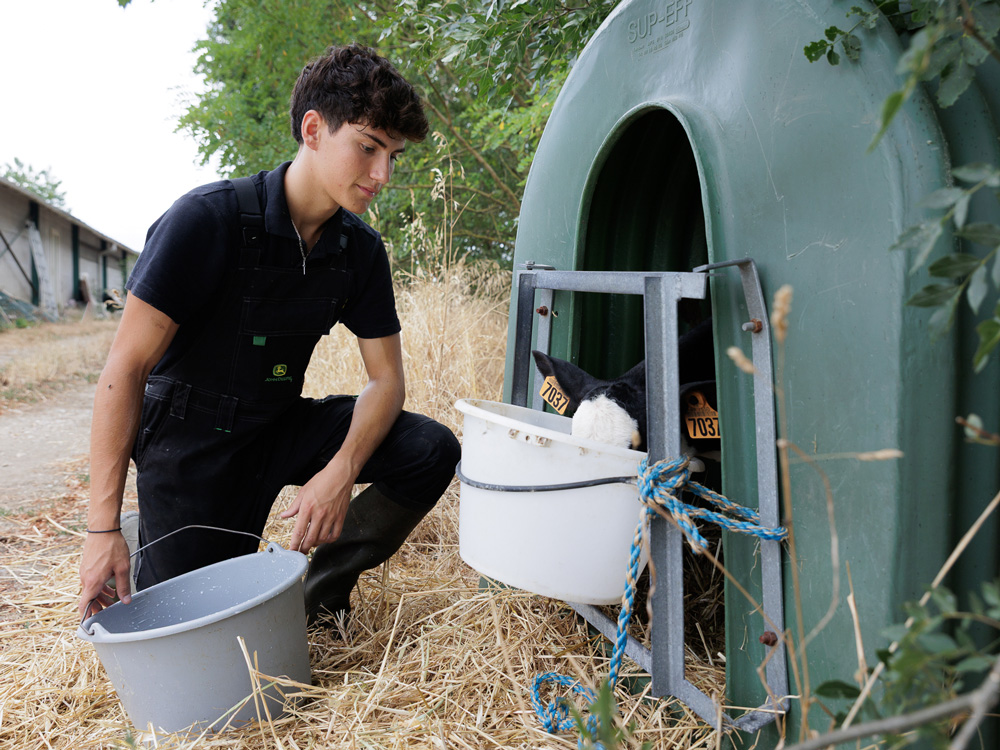
- The course includes practical training on experimental farms: animal handling and restraint, feeding management, reproduction, animal health, etc., across different livestock sectors: cattle, dairy and pigs (1 week in the first year)
- The practical fieldwork is linked to the theoretical modules on livestock management and animal husbandry.
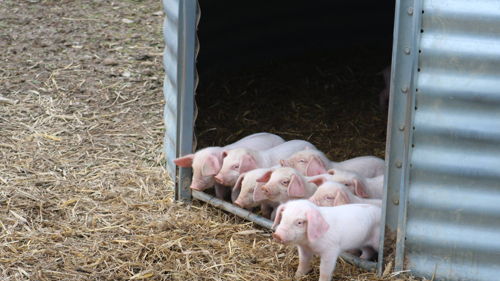
- Example: pig production – monitoring farrowing, measuring backfat thickness, assessing a batch of slaughter pigs and an animal’s health, administering injections, caring for piglets, etc.
- Putting theoretical learning into practice: visits to farms and experimental farms, and practical anatomy sessions…
- To broaden your horizons, ESA also offers a week-long discovery programme in a specific sector to help you better understand a diversification pathway: the rabbit farming sector.
- Average schedule: 2 to 3 weeks in a company and 2 to 3 weeks at the CFA ( (APPRENTICESHIP TRAINING CENTRE IN FRANCE).
- Total training hours: 700 hours per year, i.e. 1,400 hours over 2 years. Lectures, tutorials, case studies, and company visits
- Group study trip abroad.
- Continuous support throughout the programme from both teaching and administrative teams.
- Access to an online platform with learning resources (course materials, exercises, etc.), communication tools, and ESA’s digital library (19,000 referenced books in a digital catalogue, e-book platform ScholarVox, and access to databases).
- Apprentices also have access to our Language Resource Centre. This centre focuses on self-directed learning and interaction, making language learning more engaging in a friendly environment: reading rooms, individual rooms (games/DVDs), and a creativity room with a theatre stage, etc.
- Each apprentice is provided with a personalised learning logbook to track progress and the acquisition of skills required to validate the diploma.
- We provide close support in professional areas through personalised follow-up. Our environment also offers access to conferences, symposiums, inaugural lectures, international exposure, as well as opportunities to take part in competitions and projects.
- We have implemented writing support sessions, offering guidance and monitoring in written and oral expression.
Graduation requirements
The HND is accredited by the French Ministry of Agriculture, Agri-Food and Food Sovereignty.
The HND is delivered on a semester basis: the 27 skills in the curriculum, organised into 8 blocks, are assessed at the training centre through certification tests over the course of the 4 semesters of the programme.
Candidates therefore no longer sit national final examinations.
The requirements for obtaining the HND are as follows:
- The marks for the 27 competencies are linked to the 8 skill blocks
- The overall average for the 8 blocks must be at least 10/20
- The average for the 5 professional blocks must be at least 10/20
- The average mark obtained in each of the 5 professional blocks must be at least 6/20
3 good reasons to choose the Higher Technical Qualification
01.
Comprehensive training on all types of livestock farming
cattle, pigs, goats…
02.
A qualification that opens doors
A BTS acts as a stepping stone to further study.
03.
A stimulating learning environment
an educational approach that promotes independence and strong links with the world of work.
Admissions
Admission process
Required level for admission to the Higher Technical Qualification
- Create an account
- Complete the application form and upload the required documents
- Once completed submit your application form
You are an exchange student
If you are a student from a partner university you must be officially nominated by your university. Once you are nominated by your university you will receive a link to our online application form.
Advantages of the Higher Technical Qualification
International outlook
To gain a better understanding of the world, enhance your CV and gain a unique personal experience, the BTS in Agronomy and Sustainable Farming offers
- Pour une formation en alternance : A one-week group trip in France You’ll discover local agriculture and supply chains
Key advantages
- Support for students with their career plans
- The only HND courses offered at a higher education institution
- An international outlook: depending on your preferences, you can go abroad on a group trip, an individual stay or an internship.
- Close and strong links with a network of businesses at regional, national and international level.
- Employment or further study: pathways to ESA from bachelor’s to master’s level.
- A support module for those wishing to progress to engineering studies.
- Full-time initial training or apprenticeship: choose the pace of your higher education depending on the HND programme.
- A student-centred education with personalised support and teaching methods rooted in practical experience and focused on cultural openness.
- A modern and attractive campus: the resources to learn and develop.
- Living and studying in Angers, a major university city and European plant production hub, at the heart of a major French agri-food region…
- Gaining agricultural expertise.
Campus life
The ESA is a friendly place to live, open to the city and full of life!
Joining our school means:
- to have a rewarding and life-changing experience that will shape your future
- thrive through involvement in student societies (over 20 active societies, around a hundred committed students…)
- to meet and share experiences in a multicultural environment
- building a network…
Take a virtual tour of our school
Angers, an attractive city
Angers, the ‘capital of plants’ since the 19th century, a region with a ‘nature’ label… a new way to experience the city! The 18th largest city in France, at the heart of an urban area with over 300,000 inhabitants, including 47,000 students. A green and cultural city, Angers is a dynamic, ‘human-scale’ city renowned for its relaxed atmosphere and quality of life. It offers a unique living environment with landscapes listed as UNESCO World Heritage Sites.
And after ?
An Alumni network
Take advantage of the services of the AAESA (ESA Alumni Association) from the moment you enroll and throughout your professional journey: directory, testimonials, company visits, sponsorship, mentoring, events, job opportunities…
The association is a true career booster, maintaining connections with the school and fostering links between students and professionals.


TUITION FESS AND FUNDING
Tuition fees
Formule étudiante
Tuition fees* are €2,278 per year.
Additional fees:
- Student Union membership fee: €30
- Workplace accident insurance contribution: €81
- Campus Services fee: €100
Work-study Programme
Training is free for apprentices or participants on a professionalization contract.
The annual cost of the program is €. 7 894. For companies established in France, the cost may be covered by an OPCO (French skills and apprenticeship funding body).
For an apprenticeship contract, the coverage level is specified by France Compétences or the OPCO.
If the training cost exceeds the OPCO coverage level, the remaining balance will be charged to the company(remaining balance = training cost – OPCO coverage level).
It is necessary to consult your OPCO to determine the coverage level for the training.
A training agreement is established between Groupe ESA and the employer alongside the contract, specifying the qualification pursued, resources provided, training cost, and any remaining balance.
Additional fees:
- Student Union (BDE) membership fee: €20
- Group trip (first year only): €400
*Price applicable for the 2026–2027 academic year, for information purposes only

Funding
Full-time programme
- Income-based grant: use the grant calculator at simulateur.lescrous.fr
- Grants and student accommodation: complete your Student Social File (DSE)
- ESA is here to help – find all our advice on completing your DSE
Bank Loans
- A student loan of up to €15,000 is guaranteed by the French government, with no income requirements.
- A youth loan is available under the same financial conditions as the student loan, but repayment of the principal starts immediately (not after graduation).
Work-study Programme
Apprentices receive remuneration calculated as a percentage of the minimum wage (SMIC), depending on their age and the type of contract.
Information available at https://www.service-public.fr/particuliers/vosdroits/F2918
Contactez-nous : https://www.groupe-esa.com/en/contact-information-orientation/